Helios One · buyer workflow
Plex supplier portal competitors
What this comparison can decide
This page compares Plex supplier portal with a buyer-owned Helios workflow for the competitors question. Public vendor pages describe product scope; they do not prove how a particular tenant is configured. The table keeps those boundaries visible.
Sourced comparison
| Dimension | Plex supplier portal public evidence | Helios buyer workflow boundary | Decision check |
|---|---|---|---|
| Primary job | Supplier scorecards and PO sharing are described publicly | Buyer-owned open-PO review and supplier follow-up | Is the first problem a PO exception or a broader suite rollout? |
| Supplier response | The product page names EDI, email, and an integrated supplier portal | Plain email or exported rows are review inputs; this workflow does not force a supplier channel | Can a supplier answer without a new account? |
| Data and status | Public supplier instructions show portal actions | CSV-first sample; no live vendor connector is claimed | Which fields must remain in the system of record? |
| Commercials | Pricing is not publicly stated | Helios price is not stated on this comparison page | Request a quote with volume, users, and implementation scope |
| Evidence status | Public product pages are evidence of described scope, not tenant behavior | P1 status reports 0 live-tested integrations; vendor routes are unverified until tested | Require a tenant test before any write-back decision |
Prices and features that the public sources do not state are marked not publicly stated. A public description of a portal, agent, network, or document workflow is not evidence that a supplier will adopt it or that an ERP write has been tested.
Decision aid: Normalize scorecard denominators
Use on-time confirmed lines ÷ confirmed receipt lines, and report unconfirmed lines separately. Never compare a rate without its denominator.
Sample interface captures
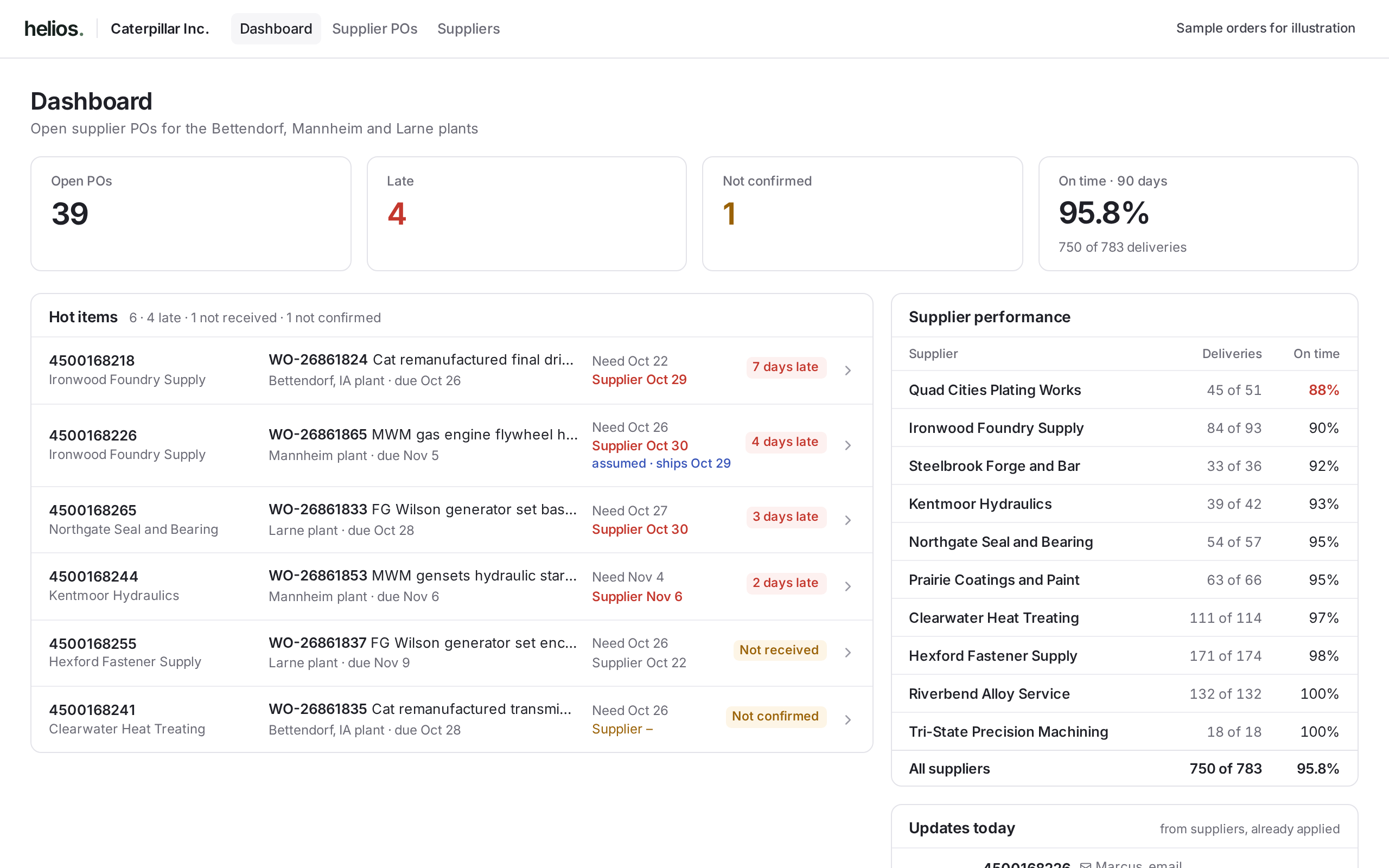
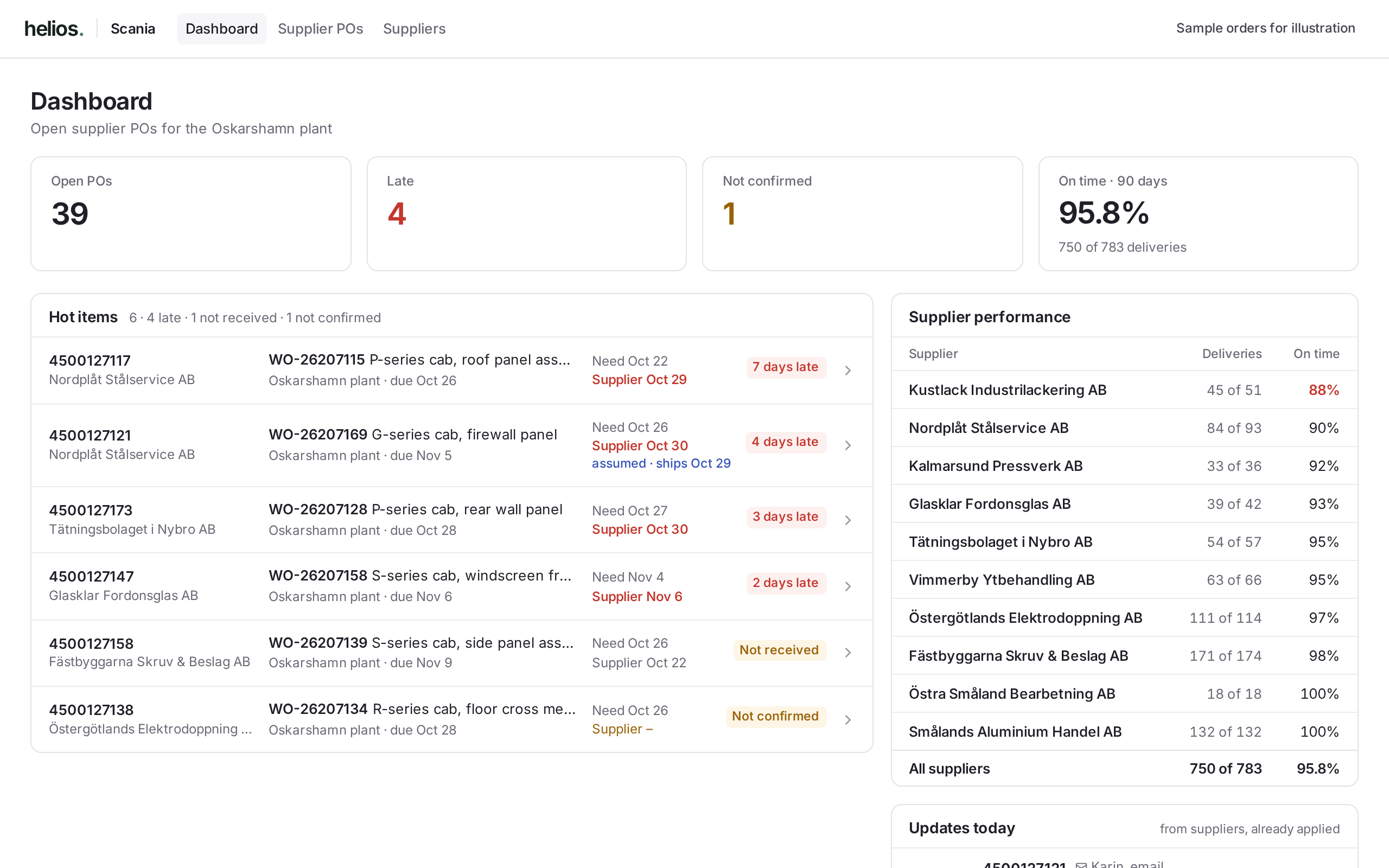
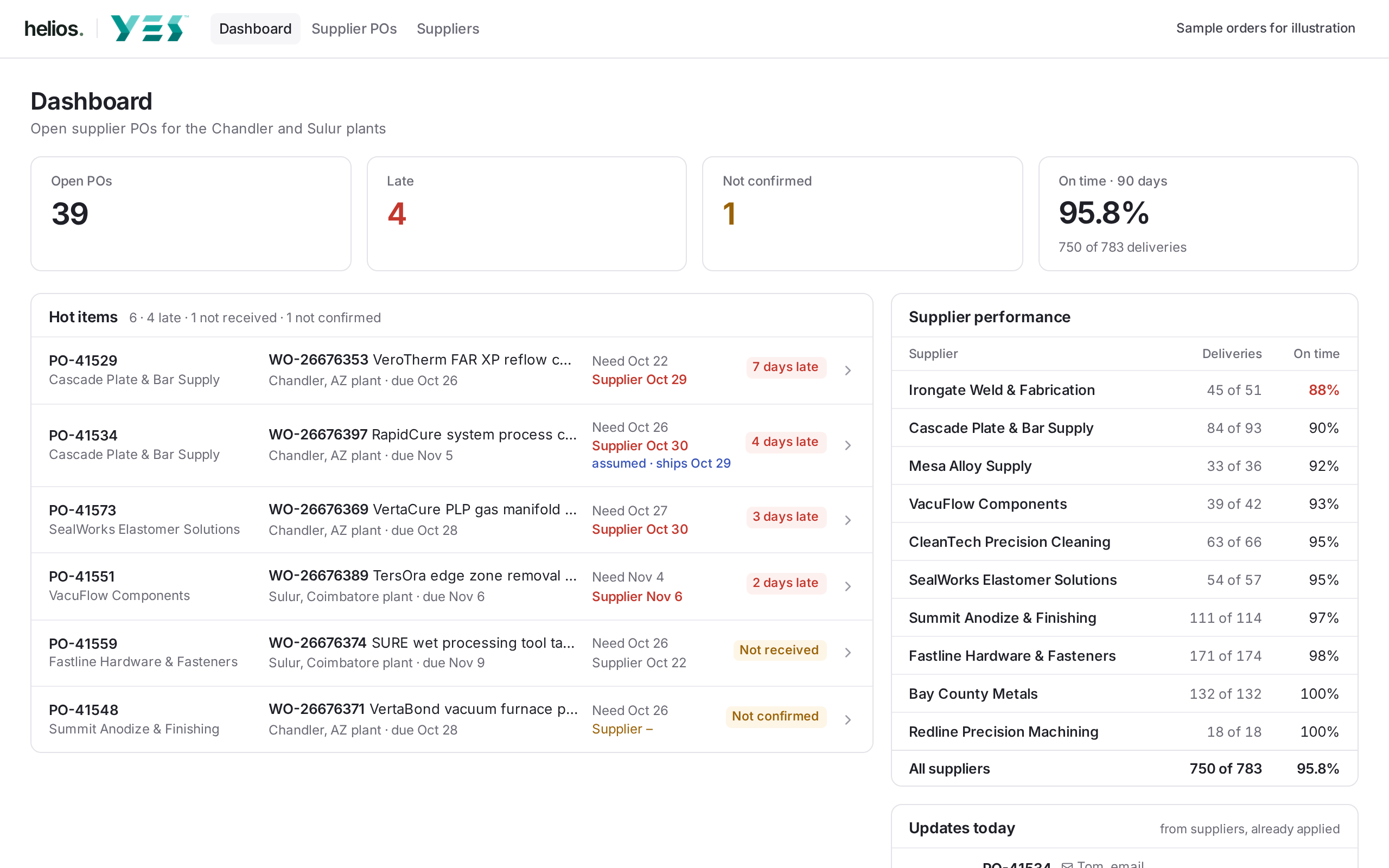
These captures come from the v4 Helios Samples proof set and show the supplier portal interface with sample/fictional data. They are not screenshots of Caterpillar, Scania, Yield Engineering, or any other company’s private system, and they contain no private company data.
Caterpillar · sample/fictional data
Scania · sample/fictional data
Yield Engineering · sample/fictional data
Worked fictional example. Fictional supplier A: 44 on time, 6 late, 10 unconfirmed. OTD is 88%; coverage is 83.3%. Supplier B with 9 on time and 1 late is 90% OTD but a smaller sample. These numbers are sample data for the calculation. Replace them with one month of your own open-PO or supplier-reply records before selecting a route.
The page-specific artifact below is browser-only and uses fictional data. It does not email suppliers, write to an ERP, or claim a live Plex supplier portal connection. For the next step, use the related workflow.
Working artifact · fictional sample data
Supplier OTD scorecard
Definition used here: receipt on or before the unmodified supplier promise date ÷ confirmed receipt lines. This sample is not an industry benchmark.
Sources and verification
- Plex suppliers and purchasing management (primary; accessed 2026-10-23) — Describes supplier scorecards and PO sharing through EDI, email, or an integrated portal.
- Plex supplier portal work instructions (primary; accessed 2026-10-23) — Shows a public supplier-facing portal workflow and required actions.
- Helios One workflow brief (internal; accessed 2026-10-23) — States the buyer-owned, browser artifact boundary and does not establish a live vendor connector.
Frequently asked questions
Does this page claim a live Plex supplier portal integration?
No. P1 status reports 0 live-tested integrations. The comparison uses public product evidence and a browser-only Helios artifact; any connector route needs tenant testing.
How should I use the decision aid?
Use the fictional example to agree on fields and a denominator with your team. It is a planning calculation, not a vendor performance or savings claim.